Author Archive for R. Oliphant – Page 19
 The videotape from the January 16, 2024 meeting of the Yavapai Community College Governing Board is still closely guarded. The Blog has made two requests for the tape but has not yet been successful in obtaining it. The most recent request is currently under review by someone whose identity remains undisclosed.
The meeting is scheduled to begin at 9:00 a.m. in the morning and run until 4:00 p.m. There is no open call to the public normally placed on workshop agendas. The possibility exists that the meeting will be live streamed for County residents to view
 The Yavapai Community College District Governing Board will hold what is described as a “Budget Workshop” at the Rock House on the Prescott Campus on Tuesday, February 13, 2024. The meeting is scheduled to begin at 9:00 a.m. and run until 4:00 p.m.
The District Governing Board normally does not include an Open Call to the Public in the agenda.
Under Arizona law, a citizen has a right to attend, listen, tape record, or videotape all of these meetings. The public may not disrupt, but may speak during the Call to the Public at the beginning of this meeting if the call is on the agenda. See Ariz. Att’y Gen. Op. No. I78-001.
You may access the agenda for this meeting at the District Governing Board’s website when it is eventually posted.
There is a possibility that the meeting will be live streamed. Check the agenda when it is posted.
The agenda must be posted at least 24 hours prior to the meeting.
Hired July 10, 2023 – Leaves seven months later with College offering no explanation; Follows resignations of Dr. Diane Ryan in July 2023 and Dr. Tina Red in July 2022
In a terse announcement to the press on Wednesday, January 31, 2024, Yavapai Community College President Dr. Lisa Rhine stated, “I am writing to inform you that Dr. Kimberly Moore is no longer employed at Yavapai College.” The only explanation offered by Dr. Rhine for the sudden departure was, “I understand that the past few months of operations in these areas have been challenging.” She did not further address the issue.
Moore was hired to head the newly created Division of Workforce and Innovation and act as its Chief Workforce Innovation Officer.
Moore becomes the third exceptionally talented administrator to leave the College’s administration in the last two years. Recall that the outstanding Dean of the Verde Campus, Dr. Tina Redd, resigned in June 2022, citing stress, excessive workload, false accusations, suspicion, and other factors as her reasons for resigning. Redd’s resignation was followed by the abrupt, surprise departure of another outstanding executive, Dr. Diane Ryan, in June 2023.

You may recall that Yavapai Community College announced in a June 13, 2023 press release the creation of a new Division of Workforce and Innovation. To head this new division, it hired Dr. Moore as its Chief Workforce Innovation Officer, starting on July 10, 2023.
Dr. Moore has an exemplary record. She served as Vice President for Workforce Innovation at Tallahassee Community College in Tallahassee, Florida. Before joining Tallahassee, Dr. Moore worked as the Chief Executive Officer and Chief Operating Officer of Workforce Plus, a local Tallahassee economic and workforce development board supporting businesses and job seekers alike. She became the first woman, minority, and youngest person in Florida to hold this key position.
Dr. Moore was recognized locally, statewide, and nationally for her service and commitment to excellence, with accolades including Tallahassee’s Top 26 Women in Business (2007), the Greater Tallahassee Chamber of Commerce Distinguished Leadership Pacesetter Award (2009), the Dr. Reginald Rolle Memorial Economic Development Champion of the Year Award (2010), Florida Diversity Council’s 2014 Florida’s Most Powerful and Influential Woman Award, Tallahassee Woman Magazine’s 2016 ‘Women Who Mean Business’ Innovator of the Year Award, induction into the Tallahassee Community College’s Hall of Fame in 2017, the 2019 Economic Innovator of the Year Award, the Florida State University – Omicron Delta Kappa (Honoris Causa) in 2020, the 2021 Idahlynn Karre Exemplary Leadership Award, the 2021 TCC Eagle Award, and the 2022 Trailblazer Award.
Erosion of openness and accountability is a dangerous precedent for a public (tax supported $100 million dollar) educational institution

Editor: Robert Oliphant
OPINION. The phrase “democracy dies in darkness” is a powerful reminder of the vital role transparency plays in maintaining a healthy democratic system. In the context of the Yavapai Community College’s District Governing Board, this saying takes on a particularly poignant meaning. By shrouding their actions in secrecy and limiting public access to information, the Board is not just deviating from its previous commitment to transparency but is also demonstrating a troubling disregard for the principles of democracy.
Democracy thrives on informed citizenry, where decisions are made in the light of public scrutiny and with the involvement of those affected by these decisions. When a governing body like the Yavapai Community College’s District Governing Board starts to limit access to information, such as meeting minutes or video recordings, it impedes the community’s ability to stay informed and hold their leaders accountable. This lack of transparency can lead to a lack of trust in the institution, as residents may start to suspect that decisions are being made without their best interests in mind or in a manner that is not reflective of their collective will.
Furthermore, the Board’s actions could be seen as setting a dangerous precedent. If a public educational institution, which ideally should stand as a beacon of knowledge and enlightenment, starts to operate as an autocracy, it encourages similar practices in other public bodies. This erosion of openness and accountability can have a cascading effect, weakening the very foundations of democratic governance.
In Yavapai County, where the residents rely on their elected officials and public institutions to act in their best interest, the Board’s shift away from transparency is particularly alarming. It not only affects the immediate functioning of the College but also reflects on the broader health of democratic practices in the region. The residents of Yavapai County are thus being shown, perhaps unwillingly, the truth of the statement that “democracy dies in darkness,” as they witness the diminishing transparency of Yavapai Community College. This situation serves as a stark reminder of the constant vigilance required to safeguard democratic values and processes against the encroaching shadows of secrecy and unaccountability.
After decades, Board puts an end to the enlightened view that Board activities should be fully transparent to the County taxpayers
 After decades of openness, the Yavapai Community College District Governing Board has made a sudden shift in its approach to transparency. The Board now requires anyone seeking draft minutes of a meeting to follow the formal process outlined by Arizona’s Public Records Act. This marks a significant departure from the Board’s decades-long policy of readily providing such information by promptly posting it on its website. Furthermore, the Board has discontinued the practice of making videotapes of meetings available within three business days, if ever. This change appears to stem from concerns that the videotapes were fostering excessive accountability and transparency, elements the Board now is eager to avoid.
This retreat from openness may be driven by fears over what residents of Yavapai County might discover about the Board’s actions. For instance, during the January 16, 2024, meeting, there was allegedly an incident involving some Board members making remarks about a Prescott woman, which triggered a kerfuffle of sorts with the Board attorney over the remarks. 
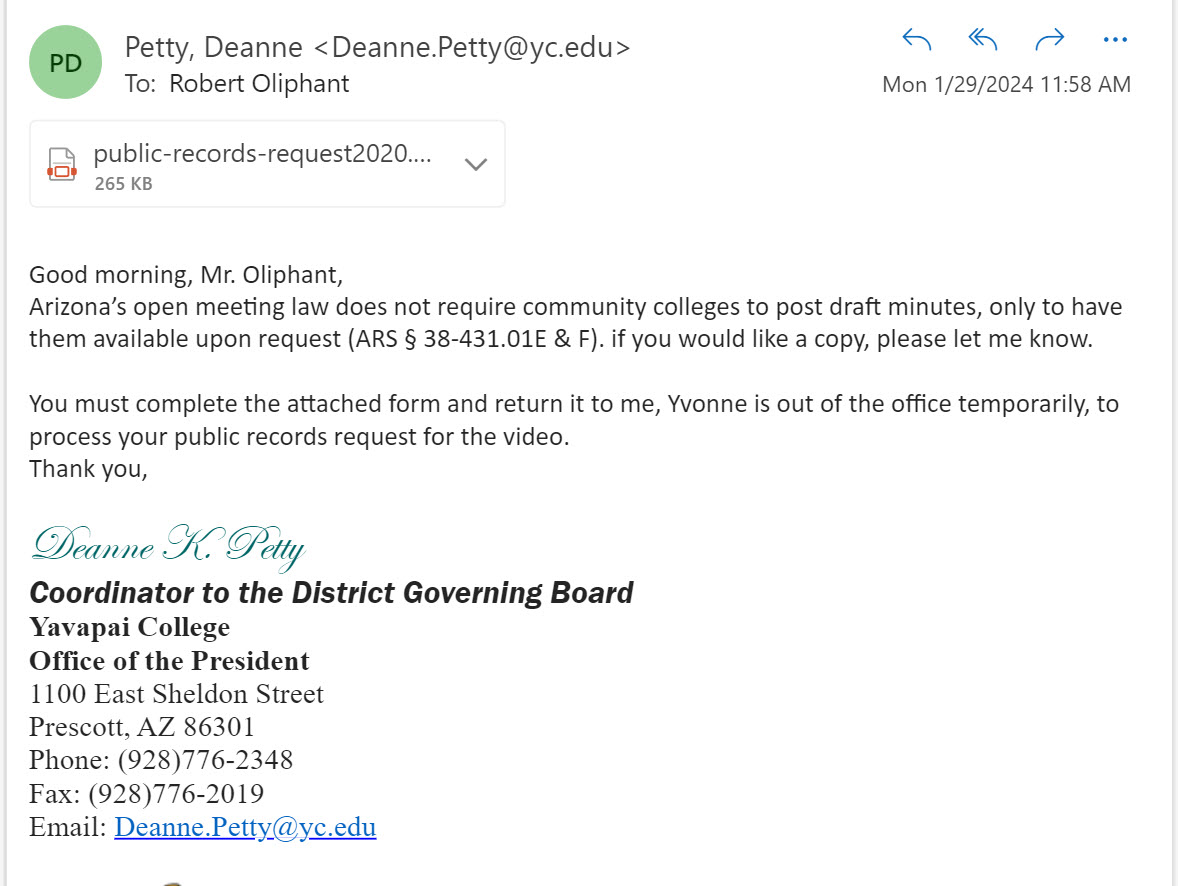
The College has informed the Blog that it will not post a draft of the minutes from the January 16th Governing Board meeting without a formal Public Records request. This move seems designed to make accessing the draft minutes as difficult and obscure as possible. Moreover, the College is also neglecting the Blog’s request for an unedited copy of the video recording of the January 16 meeting, despite a formal public records request being made for it.
Below is the letter from the College telling the Blog it must make a formal statutory request using the College’s form if it wants to see a draft of the minutes (while ignoring the request for the videotape made by the Blog).
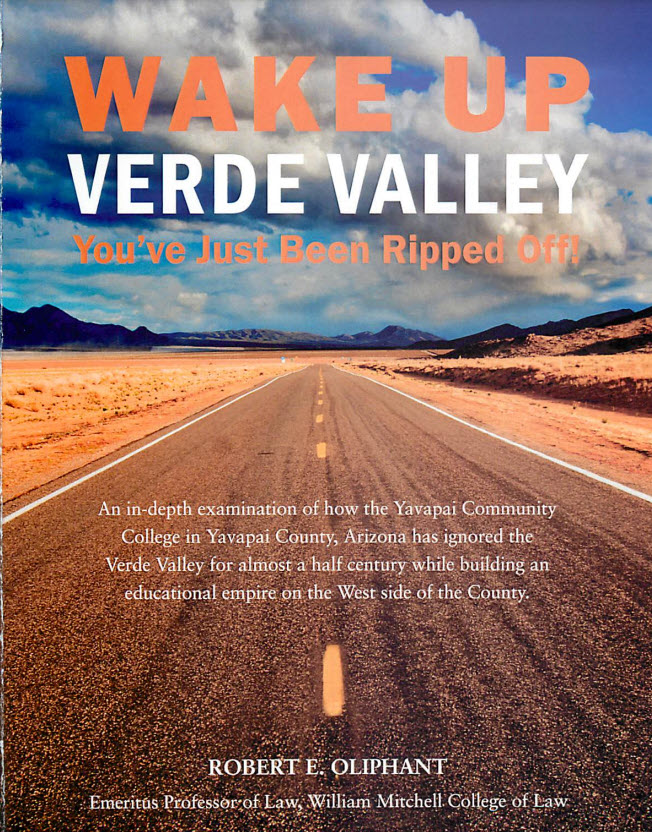
Historical, challenging, and political, “Wake up Verde Valley, You’ve Just Been Ripped Off” is a must for those interested in Yavapai County in general and the Yavapai Community College in particular
The book is free, political, and historical. It argues that for a half century there was economic educational discrimination practiced by the West Side of Yavapai County against the East side when creating and then developing Yavapai County Community College programs and facilities. There are those who no doubt will disagree. The book is now free and ready for you to download in pdf format. You should form your own opinion.
Please click on the link below and the complete 300 plus book will open. It can be read on-line or copied to your computer by right-clicking on the PDF file and then downloaded. (Please email the author any suggestions for corrections and if possible include links to any authority you may have found on the internet that support your suggestions.) Note, while the book is free, it is copyrighted.
WAKE UP VERDE VALLEY, YOU’VE JUST BEEN RIPPED OFF
Unsubstantiated suspicion and rumors are floating around the County regarding an alleged effort to hide some conversations from County residents that occurred during the January 16 meeting
 It is now over a week (Thursday, January 25, 2024, noon) and the District Governing Board has yet to provide the public with a draft of the minutes of its January 16 workshop. Neither a written draft nor the video of the meeting has been posted.
It is noteworthy that the video of the workshop wasn’t released shortly after the meeting, which is a deviation from the standard practice established over the last decade. The practice was put in place to comply with Arizona’s Open Meeting Law three-day posting rule.
Speculations arose shortly after the January 16 meeting, fueled by unsubstantiated rumors about certain conversations that allegedly occurred during the meeting, which the Board might prefer to keep from the county residents. These rumors were compounded by the unusual decision not to post the unedited video of the meeting.
The validity of these rumors remains uncertain. There are questions about whether the Board and the College are apprehensive about what the residents might learn from the video. The absence of an unedited, uncut version of the meeting video leaves a great deal of room for speculation.
Unclear why District Governing Board is allowing this to happen
 Under Arizona’s open meeting law, the minutes or a recording of a meeting shall be available for public inspection three working days after the meeting. However, as of Thursday, January 25, 2024, there has not been a post of the draft minutes in writing or via the videotape of the District Governing Board meeting that occurred Tuesday, January 16.
So far, there has been no explanation for the unusual delay. The following is Arizona’s Open Meeting Law provision:
38-431.01. Meetings shall be open to the public
A. All meetings of any public body shall be public meetings and all persons so desiring shall be permitted to attend and listen to the deliberations and proceedings. All legal action of public bodies shall occur during a public meeting.
B. All public bodies shall provide for the taking of written minutes or a recording of all their meetings, including executive sessions. For meetings other than executive sessions, the minutes or recording shall include:
1. The date, time and place of the meeting.
2. The members of the public body recorded as either present or absent.
3. A general description of the matters considered.
4. An accurate description of all legal actions proposed, discussed or taken, including a record of how each member voted. The minutes shall also include the names of the members who propose each motion and the names of the persons, as given, who make statements or present material to the public body and a reference to the legal action about which they made statements or presented material.
C. Minutes of executive sessions shall include items set forth in subsection B, paragraphs 1, 2 and 3 of this section, an accurate description of all instructions given pursuant to section 38-431.03, subsection A, paragraphs 4, 5 and 7 and other matters as may be deemed appropriate by the public body.
D. The minutes or a recording of a meeting shall be available for public inspection three working days after the meeting except as otherwise specifically provided by this article.
E. A public body of a city or town with a population of more than two thousand five hundred persons shall:
1. Within three working days after a meeting, except for subcommittees and advisory committees, post on its website, if applicable, either:
(a) A statement describing the legal actions taken by the public body of the city or town during the meeting.
(b) Any recording of the meeting.
2. Within two working days following approval of the minutes, post approved minutes of city or town council meetings on its website, if applicable, except as otherwise specifically provided by this article.
3. Within ten working days after a subcommittee or advisory committee meeting, post on its website, if applicable, either:
(a) A statement describing legal action, if any.
(b) A recording of the meeting.
F. All or any part of a public meeting of a public body may be recorded by any person in attendance by means of a tape recorder or camera or any other means of sonic reproduction, provided that there is no active interference with the conduct of the meeting.
G. The secretary of state for state public bodies, the city or town clerk for municipal public bodies and the county clerk for all other local public bodies shall conspicuously post open meeting law materials prepared and approved by the attorney general on their website. A person elected or appointed to a public body shall review the open meeting law materials at least one day before the day that person takes office.
H. A public body may make an open call to the public during a public meeting, subject to reasonable time, place and manner restrictions, to allow individuals to address the public body on any issue within the jurisdiction of the public body. At the conclusion of an open call to the public, individual members of the public body may respond to criticism made by those who have addressed the public body, may ask staff to review a matter or may ask that a matter be put on a future agenda. However, members of the public body shall not discuss or take legal action on matters raised during an open call to the public unless the matters are properly noticed for discussion and legal action.
I. A member of a public body shall not knowingly direct any staff member to communicate in violation of this article.
J. Any posting required by subsection E of this section must remain on the applicable website for at least one year after the date of the posting.
 Yavapai Community College is currently considering the addition of two more four-year degree programs to its academic offerings. Although these plans are in the very early stages, the college is seriously exploring the possibility of offering a Bachelor of Applied Science and a Bachelor of Science in Computer Science.
 The report was later featured in a press release from the Community College dated January 10, 2024. According to Lightcast’s report, it found that Yavapai College added a total of $203.7 million in income to the County economy during that time. That figure includes the Community College’s multiple roles as major employer – with payroll and operational expenditures – and local investor ($1.3 million in construction investments), as well as the impact of Yavapai’s Community College students spending locally ($10.2 million) and Yavapai Community College’s-trained personnel in the workforce ($149.2 million). The combined value is equal to approximately 2.2% of Yavapai County’s gross regional product (GRP).