Author Archive for R. Oliphant – Page 77

YAVAPAI COLLEGE PRESIDENT, DR. LISA B. RHINE SELECTED TO ASPEN ALUMNI COUNCIL

One of 12 community college presidents from across the country who will serve on the advisory council
Dr. Lisa Rhine

Yavapai College President, Dr. Lisa B. Rhine, has been selected to serve on the inaugural Aspen Presidential Fellowship Alumni Advisory Council. Dr. Rhine will be one of 12 community college presidents from across the country who will serve on the advisory council. Dr. Rhine was a member of the inaugural class of the Aspen Presidential Fellows College Excellence Program in 2018.

The Aspen Institute’s College Excellence Program aims to advance higher education practices and leadership that significantly improve student learning, completion, and employment after college—especially for the growing population of students of color and low-income students on American campuses.

“The Aspen Presidential Fellowship helped me learn and grow into a professional candidate, and I am honored to serve on the inaugural alumni advisory council,” said Dr. Rhine. “Connecting other leaders from around the country through the Aspen Alumni Fellowship will only further improve student lives by leveraging the capacity of our colleges to improve learning, access, equity, and labor market outcomes.”

The Aspen Presidential Fellowship Alumni Advisory Council will:

Assist in the recruitment and selection of future classes of rising presidents and new president fellows.

Serve as a bench of experts and advisors for Aspen to receive feedback on ongoing activities with the alumni network, new curriculum development, and needs of the network.

Coordinate touchpoints with cohorts, including virtual and in-person networking events.

For more information on the Aspen College Excellence Program, click here.

Source: Aspen Institute Facebook posting.

MINGUS HIGH SCHOOL SENIOR SADIE BACKUS SIGNS LETTER OF INTENT TO PLAY FOR YAVAPAI COMMUNITY COLLEGE VOLLEYBALL TEAM


Strong libero for the Mingus Union High School Marauders in her senior season

On Friday, November 13 Mingus Union High School graduate Sadie Backus signed a letter of intent to play volleyball at Yavapai Community College next year. It is reported that Backus was a strong libero for the Marauders in her senior season. (A person playing the libero position on a volleyball team is usually on the back row and usually the best passer on the team.)
In her last year, it was reported that she received a total of 657 serves and recorded 27 digs, which led the Mingus team. (A dig is a defensive bump that keeps the ball from hitting the floor when it’s sent to your side of the court with an offensive attack, usually a spike.)

Backus’ 27 digs constituted exactly half of her team’s total during the past season. She also recorded 155 total serves and notched 21 aces, both of which were second on the team. (An ace is when a player serves the ball and the opposing team is unable to pass it and play the ball. An ace is commonly a serve that lands untouched on the opponent’s side of the court.)

At the letter signing ceremony, Sadie’s parents Jo and Chad Backus were present and showed great pride in their daughter’s accomplishment. Jo said that “This is what she’s wanted for a long time. She’s worked hard for it and she did it. It’s awesome.”

Her father said that “Sadie’s worked a lot of years and spent a lot of time practicing, playing and working hard. She’s very disciplined in everything that she does. She deserves to be recognized. It’s awesome. We’re proud of her.”

Backus’ family, friends and teammates on the Marauders volleyball team were on hand to see her officially commit to play for the Yavapai Community College Roughriders.

Source: Michael Dixon, article November 18, 2020. http://www.journalaz.com/sports/marauders/60795-mingus-libero-sadie-backus-inks-loi-to-yavapai-college.html 

YAVAPAI COMMUNITY COLLEGE TO REMAIN IN PANDEMIC RED PHASE THE REMAINDER OF THE FALL SEMESTER

Percent of COVID-19 increasing and spreading through the communities; tests in Yavapai County grow to 25.3%

Yavapai Community College president Lisa Rhine announced via a Special bulletin on December 2, 2020 that the Community College will remain in the red pandemic phase during the remainder of the fall semester.  The president wrote that “Over the past two weeks, the percent of positive COVID-19 tests in Yavapai County has grown to 25.3%. By every metric provided by the Yavapai County Community Health Services (YCCHS), COVID-19 is spreading through our communities at a significantly high rate.”
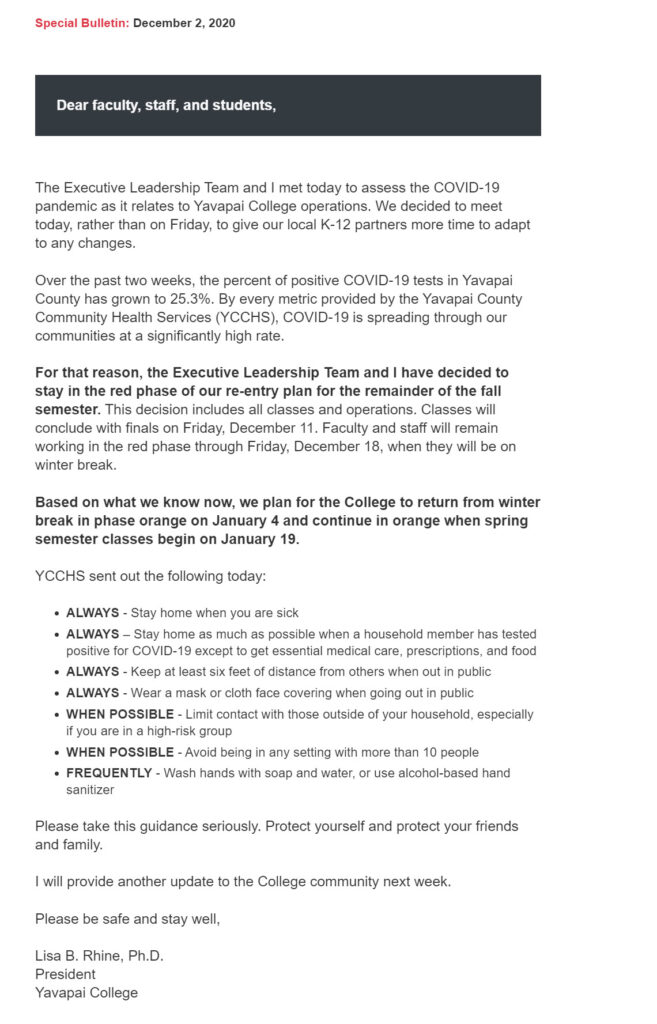

“For that reason, the Executive Leadership Team and I have decided to stay in the red phase of our re-entry plan for the remainder of the fall semester.”

You may read the entire bulletin issued December 2 below.

MARICOPA COMMUNITY COLLEGES EXPERIENCE 14.5% DECLINE IN FALL ENROLLMENT

Yavapai Community College had a 10% fall enrollment decline; state universities as a whole had  an enrollment increase this fall primarily because of online classes with only NAU seeing  fewer students

According to an article written by Rachel Leingang in the December 1, 2020 Arizona Republic, enrollment at the Maricopa Community Colleges dropped this fall by 14.5% when compared to last fall.  The Maricopa Community Colleges have seen steadily declining enrollment since 2010.

The 14.5% drop is compared to the 10% drop in fall enrollment experienced by Yavapai Community College. Enrollment in community colleges nationwide fall enrollment fell  by 9.5% this year, according to the the National Student Clearinghouse.  https://nscresearchcenter.org/stay-informed/ First-time freshmen, in particular, declined nearly 19% at community colleges nationally.

Maricopa Chancellor Steven Gonzales speculated on the causes of the decline during an interview with Ms. Leingang.  He said that private and for-profit programs that credential students have provided increased competition. According to Gonzales, they  often spend more on marketing and recruiting students and provide more hands-on support.

He also said that some students may be delaying college  because they worry for their health and safety and because they want a classroom experience that they will learn best in. Furthermore, “If you’re going to put college versus ensuring you have a place to stay and eat, and you need to go find a job as quickly as possible to just make those ends meet, you’re probably not going to choose college right now.”

It appears that students who are Native American, Black and Hispanic experienced an  even larger enrollment decline in the fall. This may be because the pandemic and its resulting economic downturn have more profoundly affected people of color.

Enrollment at each college, provided by the Maricopa Community Colleges’ Office of Institutional Effectiveness to the Arizona Republic, appears below:

  • Chandler-Gilbert Community College: 13,395 this fall compared to 15,585 last fall, a decline of 14.1%
  • Estrella Mountain Community College: 8,768 this fall compared to 10,120 last fall, a decline of 13.4%
  • Glendale Community College: 14,374 this fall compared to 18,054 last fall, a decline of 20.4%
  • GateWay Community College: 4,670 this fall compared to 5,067 last fall, a decline of 7.8%
  • Mesa Community College: 16,948 this fall compared to 20,351 last fall, a decline of 16.7%
  • Phoenix College: 9,538 this fall compared to 11,109 last fall, a decline of 14.1%
  • Paradise Valley Community College: 6,575 this fall compared to 7,900 last fall, a decline of 16.8%
  • Rio Salado College: 17,362 this fall compared to 19,103 last fall, a decline of 9.1%
  • Scottsdale Community College: 7,634 this fall compared to 8,602 last fall, a decline of 11.3%

ARIZONA ATTORNEY GENERAL MAY NOT SUE COLLEGES AND UNIVERSITIES TO CHALLENGE TUITION INCREASES RELATED TO IN-STATE RESIDENTS

AG may, however, says the Arizona Supreme Court, sue where colleges and universities have granted in-state tuition for students without legal status

Arizona’s Attorney General  sued the Arizona Board of Regents in September 2017, alleging the regents had disregarded  a constitutional provision that requires  state universities to be as close to free as possible. According to the lawsuit, over a 15-year-period  the regents had raised tuition from about $2,600 a year to as much as $12,228 a year for in-state students.

The court rejected this claim saying that if it allowed the Attorney General to proceed with the action, it would “mark a significant expansion in the Attorney General’s power that neither the constitution nor legislature contemplated.”

In a second claim in the lawsuit, the Attorney General had challenged the ability of universities and college to permit  in-state tuition for students without legal status.   In August 2019 the Arizona Board of Regents voted 8-0, with state Superintendent Kathy Hoffman to extend a tuition rate that’s 150% of in-state tuition to undocumented students. The rate was first created by the Regents for students who had legal status in the U.S. under the Deferred Action for Childhood Arrivals program.

In the spring  semester  2019 it was estimated by the University of Arizona that  329 students at Arizona State University paid the 150% rate, called the “Non-Resident Tuition Rate for Arizona High School Graduates.” That rate is about $16,000.

It is   not clear how many students paid  the 150% rate after the change. However,  each year about 2,000 unauthorized immigrants graduate from Arizona high schools, the tenth-most in the U.S., according to a report released in May by the Migration Policy Institute.

The Arizona Supreme Court said the Attorney General did have the authority to bring an action against the universities and colleges if it involved charging  in-state tuition for students without legal status.  The court pointed out that a state statute specifically provided  the attorney general with power to “recover illegally paid public monies.”

In a ruling a year ago, the Arizona Supreme Court ruled against Maricopa Community Colleges on tuition rates for DACA students, saying they did not qualify for in-state tuition. State universities, following the community colleges, were granting in-state tuition to DACA recipients.

An estimated  2,000 or more DACA recipients attended community colleges in Maricopa County, and nearly 300 were enrolled at a state university in Arizona when the ruling was issued. Once the court handed down the decision,  the Maricopa Community Colleges saw a  sharp decline in their DACA enrollments.

Sources:   Maria Polletta, Arizona Republic story published Nov 25, 2020; Rachel Leingang, The Republic | azcentral.com, August 22, 2019.

PAUL CHEVALIER ASKS FOR MORE INFORMATION REGARDING $172,671 DISCREPANCY BETWEEN TWO REPORTS GIVEN TO GOVERNING BOARD

District Governing Board votes 4-1 to table accounting report to next meeting asking College to explain the difference

Paul Chevalier

While reviewing financial reports submitted to the Governing Board for its November meeting, Third District Yavapai Community College Governing Board Representative Paul Chevalier was the only Board member to discover a discrepancy in two financial reports  that apparently should have contained identical totals.    The difference between the totals in the two reports was $172,671. 

After Chevalier raised the issue of the discrepancy in the reports during the meeting, Dr. Clint Ewell, Vice President of  Finance & Administrative Services,  agreed that  the reports should have contained  identical totals. The matter was then tabled for further discussion to the next Governing Board meeting in January  with a request that the College  explain the difference at that  meeting.

The discrepancy showed up after the College had submitted its typical regular monthly financial report to the Board that showed expenditures of $10,527,828 for the first three months of the year.  In a second report that contained a list of  the top ten expenditures from the General Fund during the same period (which included an “other” category), the total came to only $10,355,157.  Sharp-eyed Chevalier realized the totals should have been the same, calculated  the $172,671 difference, and asked for an explanation.   With no immediate explanation coming from the College accounting department, the matter was then tabled to the next meeting for further explanation.

You may view the Governing Board conversation about discrepancy in the three-minute video clip below.

YAVAPAI COMMUNITY COLLEGE ANNOUNCES IT WILL GO TO CODE RED AS PANDEMIC CASES INCREASE IN ARIZONA

Code Red in effect from Monday, November 30 through Sunday, December 6

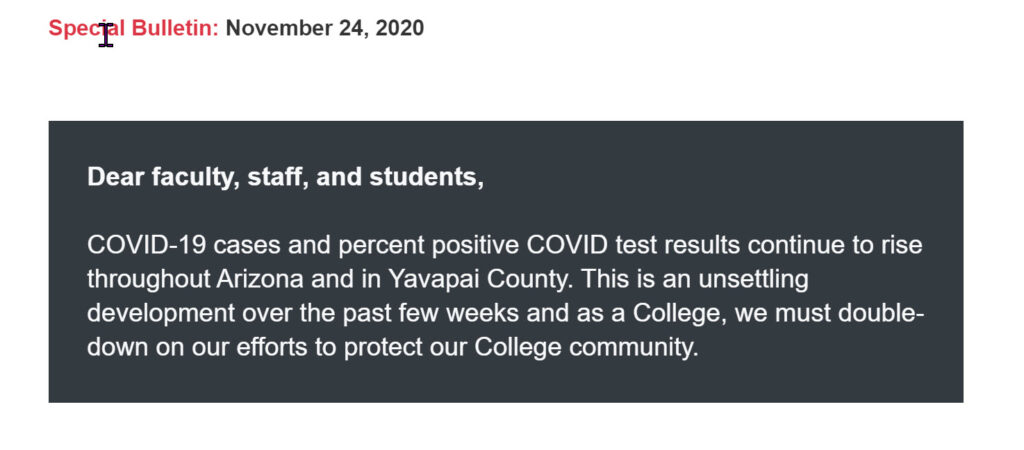
Yavapai Community College announced in a special bulletin issued  Tuesday, November 24, 2020  that it will move to the red phase of its plan to protect students, staff and others from the spread of Covid-19 effective Monday, November 30.  The Code Red phase will continue until December 6.  The fall semester ends December 11. A decision will be made on or before December 6 regarding the phase the Community College will use after that date.

The details regarding how the College will implement Code Red were included in a letter sent by president Dr. Lisa Rhine to faculty, staff and students. The letter  in the form of a special bulletin follows below.

As a result, the Executive Leadership Team has made the following decisions:

  1. Yavapai College will move to the red phase of the re-entry plan effective Monday, November 30 through Sunday, December 6.

  2. Full details of the red phase can be found on our website at www.yc.edu/reentry

  3. During the red phase:

    • All classes will move to virtual environments. No classes of any kind will meet in-person on any of our campuses or centers.
    • If students have questions about their classes, they should contact their instructors. Students, your instructors will work with you to make sure that you can complete all of your classes this semester and are ready to move on to your spring semester classes.
    • All student and public services will be offered remotely.
    • Only essential employees are permitted to be on any of our campuses or centers. If you have a question about whether you are an essential employee, please contact your supervisor. Non-essential employees should continue to work remotely during the red phase.
    • Employee keycard access to buildings will be shut off during the red phase.
    • Family Enrichment Center: The Family Enrichment Center (FEC) will follow the College’s move to the red phase and will be offering remote services. The FEC will be eligible to return in-person when the College advances back to the orange phase.
  4. The Executive Leadership Team and I will meet every Friday through the remainder of the fall semester to determine if it is safe to return to the orange phase. We will provide an update after each meeting. The next meeting will be on Friday, December 4.

  5. This decision to move to the red phase does not currently impact the College’s plans for the spring semester, and we are planning to open the spring semester in the orange phase.

I want to reiterate that College re-entry decisions are not taken lightly. I understand the impact that these decisions have on your ability to participate in classes and effectively perform your jobs. I hope you understand that it is my duty to make the best possible decisions for your health and safety, and as a College, we will continue to assess the COVID-19 pandemic with great caution.

Please continue to practice our safety protocols of wearing face covers, social distancing, and using hand and mouth hygiene. They are just as important now as ever.

As always, I urge you to be safe and make wise decisions. The virus affects every person differently, so it is imperative that we look out for one another and that each of us do our part to help slow the second wave of transmission.

I will provide another update on Friday, December 4. Please have a safe and healthy Thanksgiving holiday.

Please be safe and stay well,

Lisa B. Rhine, Ph.D.
President
Yavapai College

COMMUNITY COLLEGE SEDONA CULINARY INSTITUTE COOKS TURKEYS AND DINNERS FOR SALE AND DONATION

Cooked 63 turkeys and made 47 complete Thanksgiving dinners; donated 10 fully prepared turkeys for distribution to disadvantaged families

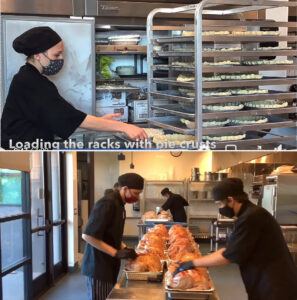
According to Facebook postings, the Yavapai Community College Culinary Institute cooked 63 turkeys and made up 47 complete dinners.  Ten of the cooked turkeys are to be donated for distribution to local families in need.

The 47 dinners were a part of an effort to cook and sell complete dinners on-line.  It appears the Institute was very successful in its efforts.

Source:  Yavapai Community College Facebook postings.

VERDE CAMPUS SOUTHWEST WINE CENTER FUNDRAISER SUCCESSFUL

Total of $17,480 donated; goal was to raise $15,000

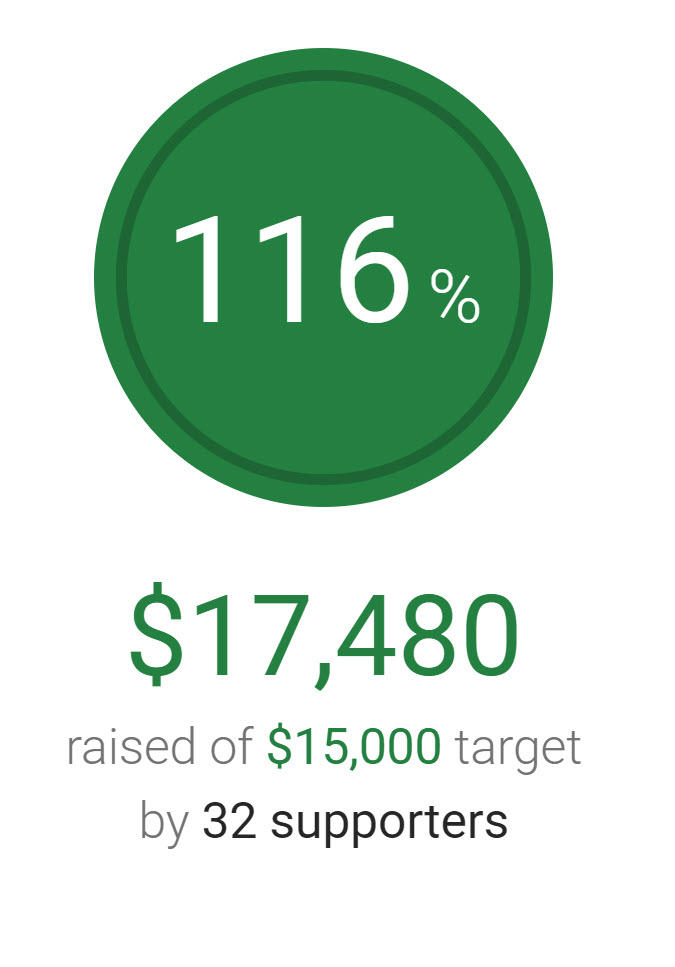
The on-line crowdfunding campaign for the Southwest Wine Center set a goal of raising $15,000.  When it ended the campaign  November 15, it had exceeded its goal by $2,480.  According to a report from the fundraising  website, there were 32 donors who contributed to the effort.

GOVERNING BOARD UNANIMOUSLY INCREASES PRESIDENT RHINE’S SALARY FOR SECOND TIME THIS YEAR WITH 4% BOOST

Overall increase puts base salary at 10% more on December 1 than it was just one year ago; while Board released no information regarding actual salary amount, based on previous President’s salary, total may be nearing $300,000

In May 2020, the Yavapai Community College District Governing Board increased College president Lisa Rhine’s base salary by six percent.  At the time, the vote was 4-1 (Chevalier dissenting) with the majority explaining the large increase was deserved because Dr. Rhine did not have a salary increase in her first year. (See video clip below for verification.) 

At the November 2020 meeting held this week, the Governing Board unanimously approved an additional four percent increase to her base salary effective December 1 of this year.  In effect, the Board has increased Dr. Rhine’s base salary a hefty ten percent this year.

Board members at the November meeting lauded Dr. Rhine for her communication and outstanding handling of the Community College during the pandemic.  Board Chair McCasland explained that in May the Governing Board was uncertain about the financial impact of COVID-19 on the College finances and “at the time we were discussing a ten percent increase.”  She said that because of the financial concern the Board  awarded Dr. Rhine a “six percent increase.”  However,  because of the current financial situation,  she was now recommending an additional “four percent increase.”

Pat McCarver took the position at the November meeting that because the Board did not give Dr. Rhine a raise in her first year, and awarded only a six percent increase, the Board was now trying to “catch up a little bit.”  She also lauded Rhine for her handling of the “COVID-19 situation.”

Paul Chevalier said the increase was merited because of her “exceptional job.” As noted above, he dissented from giving her a six percent increase in May 2020.

New Board member Mitch Padilla said that Dr. Rhine was “truly a leader on this campus” and that the handling of the pandemic was “appropriate.” He also said she has done “exceptionally well” in her “means of communication.”

It is noted that there was no mention of the almost ten percent decline in the 2020 fall enrollment by the Board.  There was also no mention at the time the six percent increase was announced in May that the Board would consider an additional increase during the year if the financial picture improved. (See video clip for verification.)

The Board carefully avoided providing the amount of President Rhine’s base salary when it made the salary increase announcement.  The Blog along with County taxpayers are left to speculate on the amount.

The last information about the Community College president’s salary came in 2017  in an article in the Verde Independent newspaper,  written by Dan Engler and published July 18, 2017. According to that three-year-old story, a wage study conducted by the Verde Valley Newspapers, Inc. showed that at the time the highest-paid County official was Yavapai Community College President Penelope Wills. The story reported her annual salary was at $277,811. According to the study, the  salary at the timed exceeded  the “second highest paying government job in the region,” which is held by the Yavapai County Medical Examiner, by $63,611.

The Blog speculates that if Dr. Rhine was hired at near the same salary as Dr. Wills was reportedly receiving, the total base salary for the Community College president is now nearing $300,000. 

You may view the brief discussion regarding the salary increase in May and the salary increase in November in the video clips below.