Starts next fall; Yavapai Community College experimenting with somewhat similar program
 It was announced December 20, 2019 that incoming students will pay no tuition or fees at Connecticut community colleges starting next fall under a plan approved by the Connecticut State Colleges and Universities Board of Regents. The Pledge to Advance Connecticut (PACT), is in response to legislation passed last spring. It guarantees that eligible in-state, full-time, first-time students at the 12 campuses will not pay out-of-pocket for tuition or mandatory fees.
PACT has four goals: (1) Mitigate excess debt for students and families, d(2) Iincrease student enrollment within the community college sector, (3) Support student retention efforts, and (4) support on-time credential completion.
Although neither as broad nor supported by Arizona legislation funding the effort, Yavapai Community College, under the direction of Dr. Lisa Rhine, has launched an experimental program somewhat similar to the Connecticut effort. Click here for details. https://www.yc.edu/v6/promise/about.html
In the fall 2019 more than 300 new students enrolled in the program. It does not apply to students seeking certificates. And there are specific requirements. For example, the Yavapai program is restricted to County residents and they must complete their degree within seven semesters after graduation from high school.
The program provides eligible students a last dollar scholarship, meaning it will cover tuition not otherwise covered by Federal, State, Yavapai College, or other 3rd party (for example, high school, Yavapai College Foundation, Tribe, employer) grants, discounts, or scholarships. However, the program will reimburse no more than 61 credits of the tuition paid by a student.
When an eligible student completes his or her coursework after seven semesters of high school or GED graduation, any tuition that was paid out-of-pocket for tuition will be reimbursed. The program is strictly limited to tuition. It does not reimburse other related expenses including, but not limited to, books, course and program fees, or other cost of living expenses such as transportation, food, and housing.
The courses taken by the student must have been paid for by the student or the student’s family, not any other source. Courses must have been taken from Yavapai College (reimbursement does not apply for transfer credits) after high school graduation or GED completion. There is no reimbursements for repeated courses or for Developmental Education credits. Aerospace Science majors and courses are not eligible (including Fixed Wing, Rotor, Unmanned, and Air Traffic).
Students are responsible to pay all their expenses up front (tuition and fees, books, cost of living). As already noted, it does not apply to certificate seeking students.
It is not clear what the final cost to the Community College will be for this program. It may be minimal because most students are eligible for Pell grants, which already pay for tuition. However, the College won’t know the full impact on its budget until two years from now when the first crop of “Promise” students graduate.
 It was reported December 23 that a free textbook program at the University of Hawaii’s community colleges has saved students more than $3.4 million since it began in 2015. To do this, the Hawaii Community Colleges are using what is called “Open Educational Resources” materials. Up to 40% of classes at on some Hawaii Community Colleges use these resources.
 Forty-eight future nurses gathered December 13 for a traditional graduation pinning ceremony at the Yavapai Community College Performing Arts Center on the Prescott campus. (Blog was informed that at least 13 are from the Verde Valley.) The nursing graduates also celebrated with a lamp lighting and recitation of the Florence Nightingale pledge. In the pledge, the graduates commit to “be loyal to my work and devoted towards the welfare of those committed to my care.”
 The Osher Lifelong Learning Institute at Yavapai College – Sedona-Verde Valley (OLLI at Sedona-Verde Valley) reported on enrollment and fundraising efforts to its members in its December 19, 2019 newsletter. The data showed a slight decline in enrollment and an increase in fundraising.
 Bob Wier, the superintendent of the Valley Academy for Career and Technology (VACTE), received the Region five Career and Technical Education Administrator of the Year in December at the National Association for Career and Technical Education’s CareerTech Vision conference in Anaheim, California. He was also one of five finalists for the National CTE Administrator of the Year award.
 Yavapai Community College’s holiday break begins December 21 and ends January 5. During that period, offices at the College will be closed.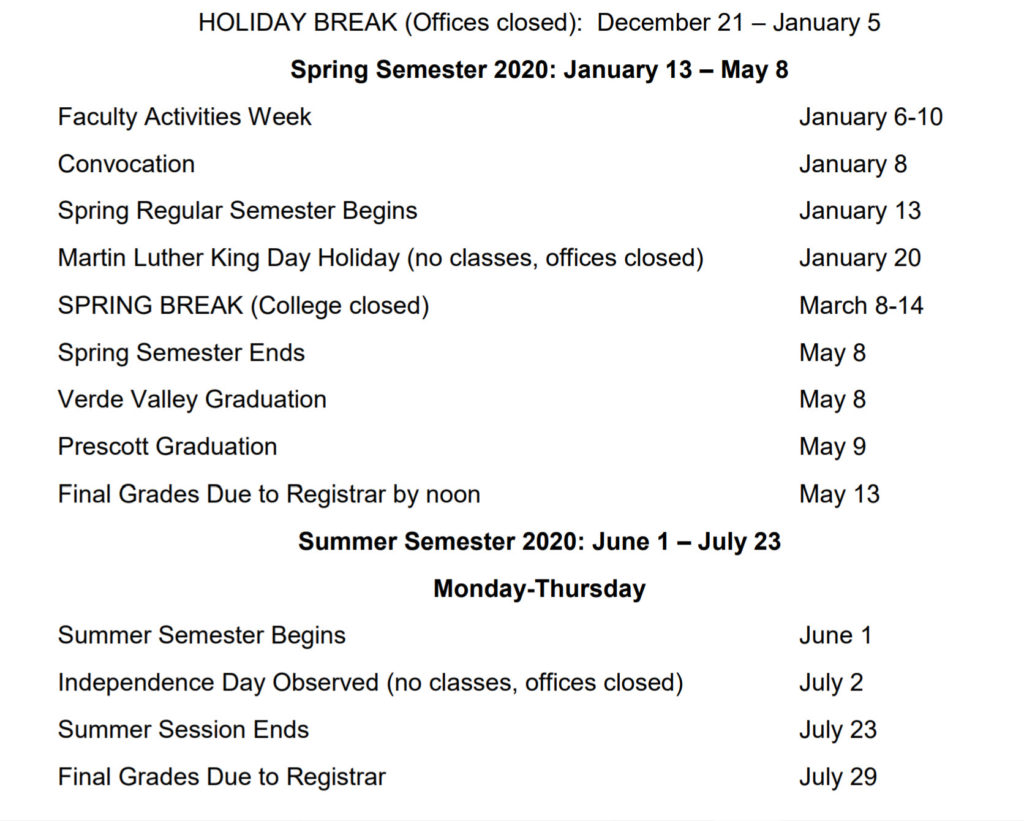
 Based on a recent story in the Prescott Courier, there are groups in Prescott who are looking to find funds to develop two new performing arts centers in that City.