Front- page story suggests that free speech provisions in the Constitution and state legislation permit elected Board members to discuss community college matters with staff and faculty and openly speak to the community about college issues that concern them because it is in the public interest to do so
 The Sedona Red Rock News published a front-page article on December 11, written by Tim Perry, that examines a controversial policy adopted by the outgoing lame-duck Yavapai Community College Governing Board at its November meeting, the last of the year. The article raises serious questions about whether the policy infringes on the rights of elected Board members to engage with staff, faculty, and the public on matters of public interest.
The new “code of conduct,” passed by the lame-duck Governing Board 4-1, explicitly restricts individual Board members from communicating with college employees. The policy states: “Under no circumstances should an individual board member direct or contact by any means a staff member concerning a college or community issue. Board members will refer all of their concerns and constituent concerns via email to the president to resolve or answer.”
Additionally, the code stipulates that “Board members do not speak to the press in any way that reflects negatively on their colleagues or the college.”
The Sedona Red Rock News article suggests that such provisions may amount to a “prior restraint” on speech, a concept that is frowned upon under constitutional free speech protections and state legislation. Legal experts argue that in general elected officials have a right—and indeed a duty—to meet with constituents, including staff and faculty, to gather information that is voluntarily offered. Such interactions are widely regarded as being in the public interest, particularly in matters concerning public institutions like Yavapai Community College.
The article’s focus underscores ongoing concerns about transparency and communication between the Yavapai Community College Governing Board, the college community, and the public at large.
You may read the entire article by clicking here: https://www.redrocknews.com/2024/12/11/ycc-president-attempts-to-seize-control-from-board/



 Yavapai Community College began live-streaming District Governing Board meetings on the College’s YouTube channel on February 20. This decision was made without any prior notice in the posted February 20 agenda or elsewhere to the public. The positive aspect is that, along with live-streaming, the meeting was posted on YouTube on February 21 for those interested in viewing it.
 educational institution, which ideally should stand as a beacon of knowledge and enlightenment, starts to operate as an autocracy, it encourages similar practices in other public bodies. This erosion of openness and accountability can have a cascading effect, weakening the very foundations of democratic governance.
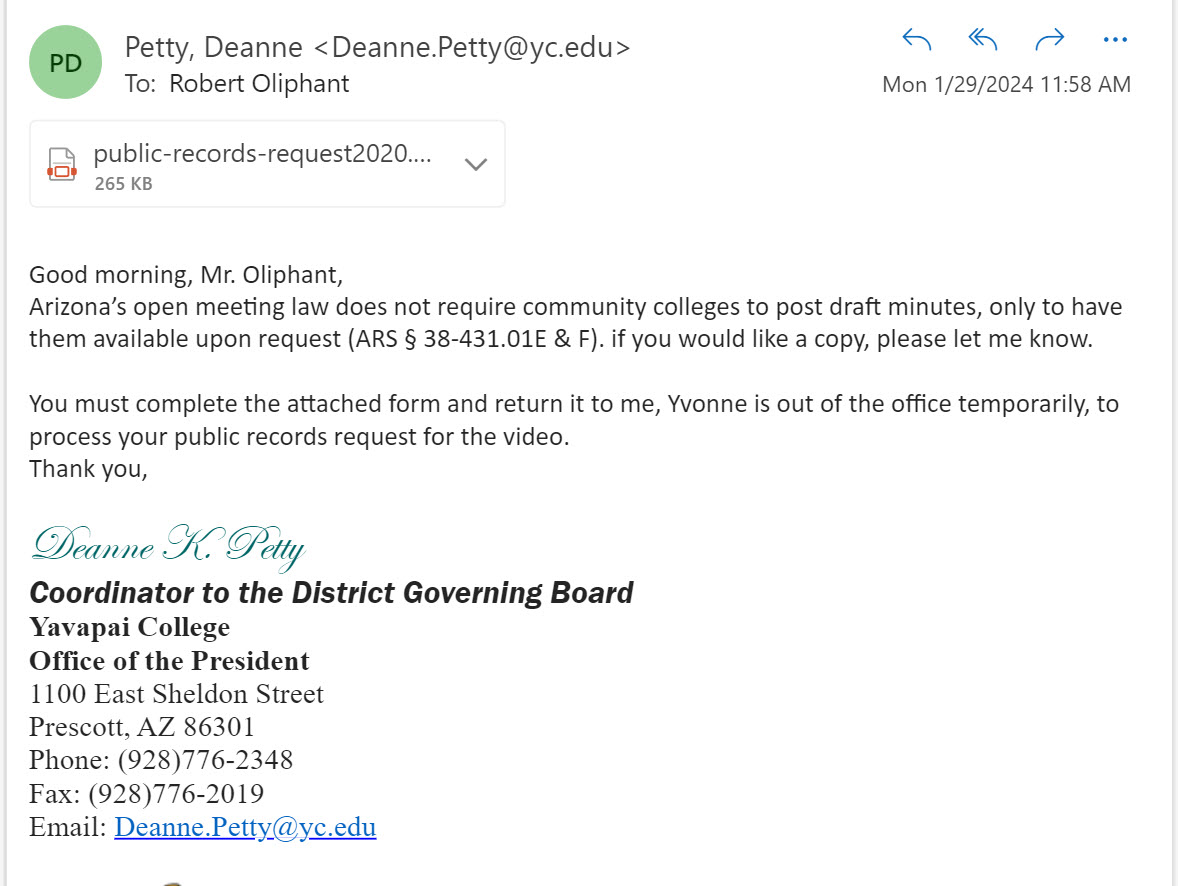
 After decades of openness, the Yavapai Community College District Governing Board has made a sudden shift in its approach to transparency. The Board now requires anyone seeking draft minutes of a meeting to follow the formal process outlined by Arizona’s Public Records Act. This marks a significant departure from the Board’s decades-long policy of readily providing such information by promptly posting it on its website. Furthermore, the Board has discontinued the practice of making videotapes of meetings available within three business days, if ever. This change appears to stem from concerns that the videotapes were fostering excessive accountability and transparency, elements the Board now is eager to avoid.