Moving significant Career and Technical Education training from Verde Campus to Prescott occurred in 2006 leaving Valley out in the cold

Commentary
Most residents of the Verde Valley are unaware of the enormous Career and Technical Education program in Yavapai County. This article will explain the history and development of CTE in the County as it affects the Verde Valley.
The Valley Academy for Career and Technology Education Center (VACTE). VACTE operates the Joint Technical Education District (JTED) for the Verde Valley. It coordinates Career and Technical Education (CTE) training in the Valley with the three high schools located there. The Mountain Institute is the JTED on the West side of the county. It coordinates CTE training for all high schools over there. Yavapai College provides advanced, state-of-the-art CTE training on its CTEC Campus at the Prescott airport.
Few are aware of the enormous disparity in CTE learning opportunities offered by the two JTEDs. If you live on the West side of the County, there are CTE learning opportunities in aviation, line-worker, and a host of other sophisticated/advanced skills programs. If you live on the East side, you do not have access to most of those wonderful learning opportunities. Unfortunately, almost all of the inequity has to do with the Community College and its investment in Career and Technical Education training on the West side of the County.
Consider for a moment that Mountain Institute high school students on the West side of the County have earned about 9,000 CTE college credits since it began in 2008 mainly because the JTED over there has arranged for them to take CTE courses at Yavapai College’s CTE Campus. By comparison, high school students on the East side of the County (Verde Valley/Sedona) have never taken any courses at the College CTE campus and have no doubt earned far fewer CTE college credits at the three area high schools since the JTED over here (VACTE) began in 2000.
For non-high school students, reasonable access to CTEC in Prescott is a problem because of Mingus Mountain. The drive and distance makes it difficult, sometimes impossible, for the unemployed, single working parents, and part-time employees to take dozens of CTEC classes only offered on the West side of Mingus. (There is neither public nor College transportation to CTEC from the Valley.) These are persons who some argue are most in need of such training.
Community College politics explains why the CTE Campus and its sophisticated skills programs ended up on the West side of the County. Ironically, voters in 2000 approved spending millions of dollars to develop a state-of-the-art CTE training center on the East side of the County at the Verde Campus. It was a part of a $69.5 million bond issue. It was to be called the “Northern Arizona Regional Training Skills Center.” The Federal Government provided the College with over a million dollars to support the Center.
Professor Paul Kessel, the chief operational officer for the Verde Campus at the time, stated that: “[T]he (center) will provide much-needed educational space and resources to further develop job training programs to benefit residents of northern Arizona. This is an exciting and unique opportunity for northern Arizona residents to gain specific work related skills that will allow citizens to seek immediate employment or increase their level of income in a current or new position.”
However, the hopes and dreams of developing a thriving CTE College skills program on the Verde Campus were not to be.
The Center opened with great fanfare on the Verde Campus in 2004. However, before it got its feet on the ground, it was shuttered by a “new” College administration in Prescott a little over two years after it got going. That’s Yavapai College power politics at work.
Most of the Verde Campus skills programs were either moved over the mountain to the CTE Campus or eliminated. This resulted in VACTE losing the ability to closely coordinate and cooperatively develop a facility on the East side of the County like the one the College birthed in 2007 at the Prescott airport and just spent $6 million to upgrade.
Since 2008, the College and the JTED on the West side of the County have intimately worked together to coordinate and develop CTEC training at the College’s CTE center. Neither of the JTED’s on the West or East side of the County have revenue to purchase costly machinery or support extremely costly programs. However, the College is a gushing river of revenue with grants, property taxes, tuition, and state aid annually flowing to it. Since 2008 the College has invested an estimated $15 to $20 million at the CTEC Campus on renovation and purchasing the costly machinery JTEDs could not afford. It has not made a similar investment in the East County JTED and it has not made a future commitment to do so.
Since moving skills training to CTEC the College has done little to encourage an intimate association with VACTE. It typically uses as an excuse that VACTE is a “different model” than the Mountain Institute JTED. However, it never explains why the difference prevents it from remedying the absence of programs over here that are offered over there.
The College has responded to recent community pressure and opened a small culinary training program in Camp Verde and returned welding and a couple other CTE courses to the Valley. But little else.
Given this history, there are two burning questions: First, “why has the College been allowed to provide dozens of advanced CTE training opportunities that are only available to children and residents who live on the West side of Mingus Mountain?” Second, “will East County residents continue to allow Career and Technical Education learning opportunities denied their children and many residents for a decade to continue for the next half century when the Community College has millions of dollars it could use to remedy the problem?”
 Historic meeting of V’ACTE and Community College Governing Board set for Monday
 As you know, if you are a regular reader of this Blog, Yavapai Community College offers Career and Technical Education training at CTEC, a state-of-the-art facility. It houses courses designed to confer certificates and AAS degrees in 12 different job-training areas. One of the newest tech ed offerings is the lineworkers program.
 Aviation Technologies is a two-year program. Year one is devoted to fixed-winged flight, with students completing simulation labs in take-off, landing, and maneuvering an airplane in real-world situations. This past summer, Yavapai College completed its new helicopter simulator lab, and as a result MIJTED’s year-two aviation students are focusing on helicopters and utilizing the new facility, which features simulators that react as if the students are in flight, including realistic sound, motion and vibration.
 Students also have the opportunity to take classes in air-traffic control. Though they are in different rooms, students in the air-traffic control lab can send voice commands to students in the fixed-wing or helicopter simulators. This technology enables them to realistically direct aircraft to take-off, land, or go into a holding pattern, and enables the students in the flight simulators to become experienced in processing air-traffic control commands.
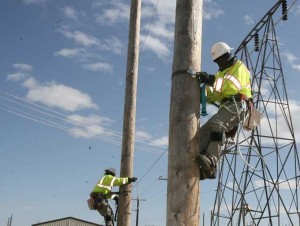 Over 200 high school students in the Prescott area are estimated to enroll this fall in vocational training classes at the Prescott CTEC campus. Some of them will seek an electric line worker certificate. Almost immediately after completing the two-year course, they will be hired at a lucrative beginning salary. Sad to say that not a single Verde Valley high school student will be enrolled at CTEC this fall.