Image
  • Home
  • Contact

THE EXHIBITION TITLED “SUSTAINABLE ART” WILL SHOWCASE ARTWORKS MADE FROM REPURPOSED MATERIALS FROM FEBRUARY 25 THROUGH MARCH 27 AT THE PATTY MCMULLEN-MIKLES GALLERY ON THE VERDE CAMPUS.

By R. Oliphant
Tuesday, February 18th, 2025

Opening reception on Thursday, March 6th, from 5:00 to 7:00 p.m.

The Patty McMullen-Mikles art Gallery on the Verde Campus will host a unique exhibit starting February 25 and running until March 27.  An opening reception for the exhibit, Sustainable Art, will be held Thursday, March 6 from 5 – 7 p.m.

The gallery is open to the public Tuesdays, Wednesdays and Thursdays through March 27, from 10:00 a.m. to 3:00 p.m. Note: The Gallery will be closed for Spring Break March 17 – 21. For more information about Sustainable Art or the McMullen-Mikles Gallery, please call (928) 649-5479.

A Community College press release described the exhibit as part of a movement to create new art from old or repurposed materials. This concept is known as Sustainable Art.

According to the press release, “Sustainable Art celebrates works created with sustainable practices. Metal Sculptor Paul Klaine selected 15 artists to exhibit a diverse range of artwork made from eco-friendly, up-cycled and recycled materials. The result is exciting mix of Collage, Mixed Media, Assemblage pieces and more.”

“A Southern California native, Paul Klaine specializes in scrap metal sculptures. His affection for metal sculpting began when his parents gave him a MIG welder as a gift more than 25 years ago. He began building and selling sculptures at art festivals, specializing in animal sculptures, authentic lamps and taxidermy wall pieces. Paul now lives in Prescott, where he is represented by the Ian Russell Gallery of Fine Art, and builds commission pieces derived from old car, motorcycle and bicycle parts for clients and collectors all over the world.”

The reception on March 6 from 5:00 to 7:00 p.m. is free and open to the public. Complimentary hors d’oeuvres will be provided, and wine will be available for purchase from the Southwest Wine Center. 

Categories : Art programs

DISTRICT GOVERNING BOARD SETS MEETING FOR TUESDAY, FEBRUARY 18 TO BEGIN AT 1 P.M. AND MAY RUN TO ABOUT 4:00 P.M.

By R. Oliphant
Saturday, February 15th, 2025

Meeting to be held on zoon as mystery surrounding Chair’s sudden announcement of “safety concerns”  remains a carefully guarded  secret

The Yavapai Community College District Governing Board will hold a meeting on Tuesday, February 18, via YouTube. The meeting was originally scheduled to take place at the Rock House on the Prescott Campus. However, Board Chair Deb McCasland abruptly changed the format to a virtual Zoom meeting, informing the Board in part that “after learning of safety concerns related to our board meetings,” she “decided that governing board meetings will be held virtually until further notice.”

The alleged “safety concerns” remain a complete mystery, as McCasland has steadfastly refused to disclose any details to Governing Board members or the public.

The meeting is scheduled to begin at 1 p.m. and is expected to conclude by 4 p.m. A live stream will likely be available at https://www.youtube.com/user/YavapaiCollege.

It appears the first order of business will be a closed executive session, which may pertain to the undisclosed safety concerns that prompted the abrupt transition to a virtual format. The meeting notice for this session states:

Executive Session:
i. A.R.S. §38-431.03(A)(8) and §38-431.03(A)(9) – Discussion and consultation with college representatives regarding facility safety and security measures. – PROCEDURAL {Time: 20}.

The only other agenda item of likely interest to most county residents is a discussion titled:

“Upholding Yavapai College District Governing Board Resolution Reaffirming Delegation of Authority and Accountability to the President – Resolution 2024-18” – Board Chair Deb McCasland.

Notably, there is no call to the public on the agenda.

Under Arizona law, the public has the right to attend, listen, record, or videotape the meeting, provided they do not disrupt the proceedings. For more information on these rights, refer to Arizona Attorney General Opinion No. I78-001.

Categories : Meeting Notice

IS THE DISTRICT GOVERNING BOARD GOING TO HIDE BEHIND ZOOM?

By R. Oliphant
Wednesday, February 12th, 2025

Where is the evidence of Chair McCasland’s “safety concerns” for holding meetings at the Rock House on the Prescott Community College campus? Or elsewhere?

Editor: Robert Oliphant

OPINION: The Chair of the Yavapai Community College District Governing Board, Deb McCasland,  has unilaterally decided that all future board meetings will be held exclusively via Zoom. This apparently includes meetings at the Rock House on the Prescott Community College campus or anywhere else.

Her stated reason? A vague and unsubstantiated email statement received by District Governing Board members sent by the Board Executive Assistant to the President & District Governing Board, which declared in part “that [Chair Deb McCasland] after learning of safety concerns related to our board meetings, . . . has decided that governing board meetings will be held virtually only until further notice.”  This raises an obvious question: What safety concerns?

Despite repeated requests for clarification from some Board members, Ms. McCasland has refused to provide any specific details about what threats, incidents, or conditions necessitate such a drastic shift in how the public Governing Board meetings are held.  If there were genuine concerns about safety—such as specific threats, past disruptions, or law enforcement recommendations—one would expect some form of documentation or at least a public acknowledgment of the issue. But instead, Ms. McCasland  has chosen silence.

The public deserves answers in situations like this for several reasons:

  1. Public safety is an issue concerning the entire community.  If there is a legitimate threat, the community has a right to know. Are there security concerns that affect not just the Governing Board, but also students, faculty, or the broader public? Keeping people in the dark about potential dangers does not enhance safety—it undermines it.

  2. There are potential drawbacks to transitioning to Zoom meetings. For example, it tends to limit a spontaneous response between Governing Board members who are engaged in discussion, reduces opportunities for face-to-face accountability, and allows board members to retreat into a digital echo chamber where tough questions can be most  easily ignored.

  3. Avoiding answering hard questions from Board members is not a valid safety concern. In recent months, public frustration with the Board appears to have grown—particularly over issues like free speech of Board members and taxation. Some members of the Board have been raising these uncomfortable issues.  Could this shift to Zoom be an attempt to electronically silence criticism from certain Governing Board members by easily preventing their questions by muting them with a simple click  rather than a response to an actual threat? Without evidence to the contrary, that suspicion is entirely reasonable.

  4. Other Public Bodies in the County Continue to Meet in Person. City councils, school boards, and other governing entities across Yavapai  County continue to hold public meetings without issue. If they can maintain both safety and accessibility, why can’t the College Board?

  5. No Governing Board members have publicly reported any safety threats. Neither the first nor third District Governing Board member representatives, when interviewed, could recall any safety concerns that arose during recent Governing Board meetings.  Moreover, during the last two January Governing Board hearings, there has been no public disruption of any kind.  In fact, public attendance has been almost nonexistent.

The District Governing Board serves the public, not the other way around. The decision to eliminate in-person meetings should not be accepted without clear, compelling evidence that it is necessary. If safety is truly at risk, the Chair and Board should provide concrete information and work with local authorities to ensure that in-person public meetings can still take place safely and transparently.

Until that happens, this decision looks less like a measure for public safety and more like a move to shield Board members and the College from accountability. That is unacceptable. The community should demand answers—and insist that public meetings remain in a typical public in-person format, not on zoom.

Categories : Editorials/Essays, OPINIONS

ANALYSIS BY YAVAPAI COMMUNITY COLLEGE SUGGESTS YAVAPAI COUNTY FACES SEVERE SHORTAGE OF DOCTORS AND NURSES

By R. Oliphant
Tuesday, February 11th, 2025

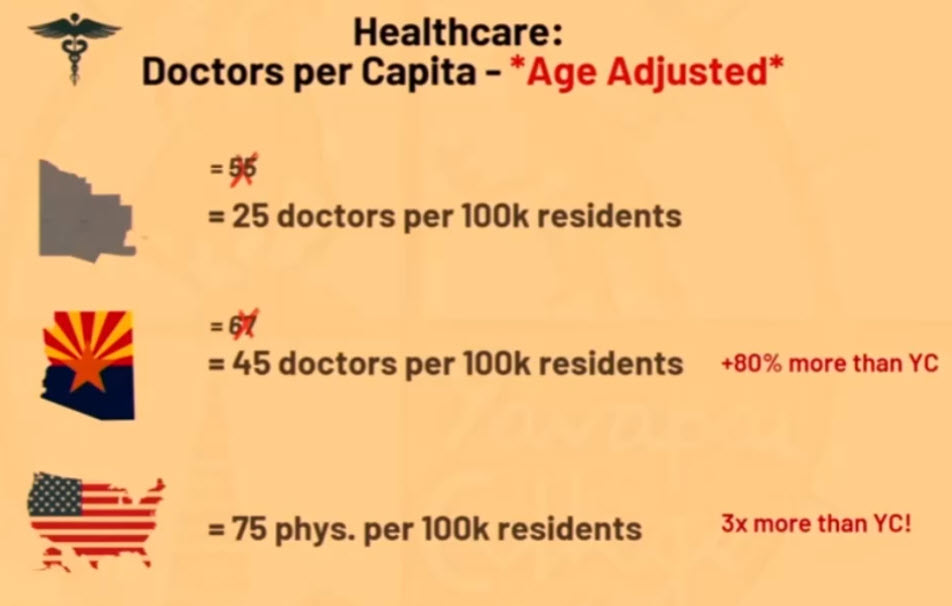
Yavapai County lags far behind the rest of Arizona and the nation when it comes to numbers of doctors per thousand of residents when adjusted for population age

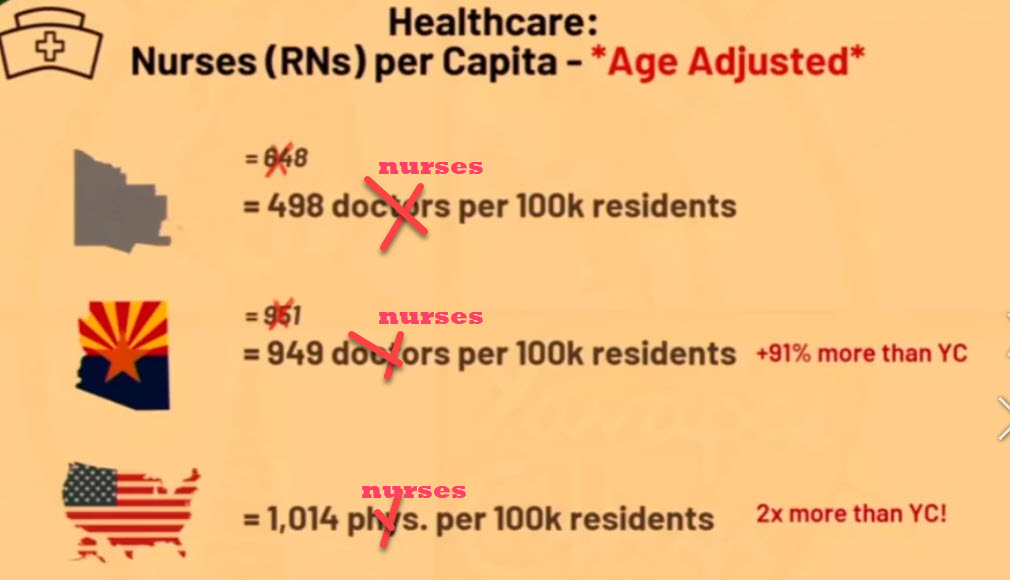
Yavapai County lags significantly behind the rest of Arizona and the nation in the number of doctors and nurses per capita, according to a report presented by Yavapai Community College. The discouraging analysis was shared with the College District Governing Board at its January 28 workshop.

At first glance the report says that the number of doctors per 100,000 residents in Yavapai County may not seem drastically low. However, when adjusted for the County’s older population and its increased healthcare needs, the data paints a much bleaker picture.

For instance, while Yavapai County officially reports having 55 doctors per 100,000 residents, this figure drops to 25 per 100,000 when accounting for the greater medical demand of an aging population. By comparison, under the same adjusted assumptions for age, the state of Arizona has 45 doctors per 100,000 residents—80% more than Yavapai County. Nationally, the number rises to 75 doctors per 100,000, three times higher than Yavapai County’s adjusted figure.

A similar trend is seen among nurses. After adjusting for the County’s older population, Yavapai County has 498 nurses per 100,000 residents. In contrast, Arizona as a state reports 949 nurses per 100,000—91% more that Yavapai County—while the national average stands at 1,014, more than double Yavapai County’s figure.

The analysis was conducted by Yavapai Community College economist and data analytics expert Ryan Jones, with assistance from Vice President of Finance and Administration Clint Ewell. The adjustment for age was based on data indicating that Yavapai County’s population is 50% older than the national norm, leading to significantly higher medical care needs.


Above slides were prepared and presented by the Community College to the Governing Board at the January 28,m 2025 workshop.


Categories : Yavapai Community College

CHAIR MCCASLAND ABRUPTLY SHIFTS YAVAPAI COMMUNITY COLLEGE DISTRICT GOVERNING BOARD MEETINGS TO ZOOM BECAUSE OF UNSPECIFIED “SAFETY CONCERNS”

By R. Oliphant
Friday, February 7th, 2025

Provides no evidence or examples  to Board members supporting the decision; Representative Payne asks for information regarding the nature of the concerns and fears that the zoom mode of communication may interfere with Board open discussion of issues

On Thursday afternoon, February 6, 2025, members of the Yavapai Community College Governing Board were notified via email that, due to unspecified “safety concerns,” future Board meetings would be held on Zoom. The notice stated that Chair McCasland “believes this will allow all meeting attendees, including the public, to participate in a safe setting.”

McCasland provided no examples or further explanation for the abrupt and somewhat alarming decision. Third District Representative Toby Payne sent an email to Chair McCasland requesting clarification about the “safety concerns” that prompted the switch to Zoom meetings. So far, there has been no reply.

When questioned by the Blog about McCasland’s safety concerns, Payne indicated he was unaware of any. When asked if he had received any threats, he responded, “No.”

It is noteworthy that so far the Governing Board has held two workshops with each lasting around six hours in the month of January. There was no opportunity for the public to speak at either meeting.  There were few, if any, members of the public at either meeting.

The relevant portions of the two emails are set out below:

(Email from Yvonne Sandoval, Executive Assistant to the President & District Governing Board)

Sent:  Thursday, February 6, 2025 2:15 PM

Subject: Important Statement from Board Chair McCasland

“Good afternoon, Board Member,”

“Per Board Chair McCasland’s directive, letting you know that after learning of safety concerns related to our board meetings, she has decided that governing board meetings will be held virtually only until further notice.  Meetings will be live-streamed and recorded in the same way governing board meetings were handled during pandemic closures.  We will provide notice of this change to the public on our website, and the information will also be included on all meeting agendas.  She believes that this will allow all meeting attendees, including the public, to participate in meetings in a safe setting.“

Mr. Payne’s response:

“Chair McCasland:

“Please explain to all the Board members what your “Safety Concerns” are that have prompted you switch to a Virtual Meeting for the Yavapai College Board.  I believe this will hinder the free flow of discussion.”

Toby Payne

Categories : ADMINISTRATION, District Governing Board

YAVAPAI COLLEGE GOVERNING BOARD REVIEWS “HOPE” REPORT CLAIMING 6% OF STUDENTS ARE HOMELESS

By R. Oliphant
Friday, February 7th, 2025

Expert questions some of the survey methods but acknowledges homelessness percentage  of student population  appears high

At the January 28, 2025, Governing Board meeting, Yavapai Community College economist and data analytics expert Ryan Jones presented an analysis of a recent HOPE survey that showed the percentage of homeless students within the College’s student population. According to the survey—produced by Temple University and distributed to participating colleges, including Yavapai Community College—six percent of Yavapai’s student body reported experiencing homelessness at some point in the past year.
Jones described the figure as “startling and significantly higher than . . . the national or state level.” By comparison, he noted that the national homeless population is approximately one-quarter of one percent of the overall population.

Jones expressed guarded skepticism about the survey’s methodology. “I’m not 100% confident in how the survey frames its questions,” he said, adding that some of the wording appears to be leading rather than neutral.

During the Governing Board discussion, it was noted that many of Yavapai’s students tend to come from less affluent families in the community. Consequently, the student survey may not accurately reflect the percentage of homelessness in the county.

Regardless of the potential weaknesses of the survey, which was self-reported, the overall conclusion appeared to be that a significant percentage of students felt they had been homeless in one way or another during the past year.

If you follow the link posted below, you will find a video clip of some of the discussion at the Board meeting on this topic. It is more detailed than the summary above. 

LINK https://app.screencast.com/OjoWj6n0OOdx8


Categories : POVERTY

EIGHT NURSING STUDENTS RECEIVE COMMUNITY HEALTH CARE SCHOLARSHIPS

By R. Oliphant
Friday, February 7th, 2025

Since 2011, program has  provided  $1.7 million in scholarship aid to  216  YCC nursing and radiologic technology students

Yavapai Community College recently hosted a reception to recognize eight nursing students who received full-tuition Community Healthcare Scholarships.

The scholarship program was established in 2011 through the generosity of the late Seymour Baskin and his late wife, Sandy. Their initial contribution, made in partnership with the Jewish Community Foundation of Greater Prescott and the Yavapai College Foundation, laid the basis for this initiative. Since its inception, the program has provided at least 216 nursing students with a total of $1.7 million in tuition assistance.

This year’s scholarships were funded by multiple donors, including the Jewish Community Foundation of Greater Prescott, the Yavapai College Foundation, Fain Signature Group, Mike and Tammy Fann, the Harold James Family Trust, Dignity Health Yavapai Regional Medical Center, the Margaret T. Morris Foundation, Beck Legacy Group, and Prescott Radiologists LLP.

The 2024 scholarship recipients are:

  • Janet Acosta
  • Taliea R. Bice
  • Elizabeth D. Bojorquez
  • Tristan W. Cluff
  • Ruth A. Lusk
  • Talia R. Peralta
  • Danielle R. Swartz
  • Kyle “Zack” Z. Szekely

The event celebrated the students’ achievements and highlighted the ongoing support from community donors in fostering the next generation of healthcare professionals.

Categories : Scholarships

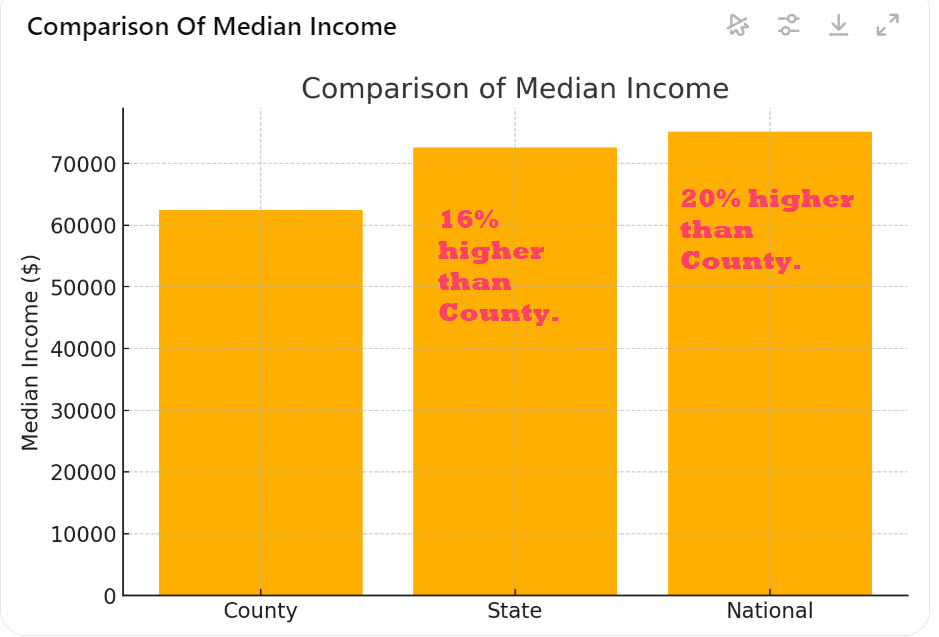
At the January 28, 2025, meeting of the Yavapai Community College District Governing Board, Community College economist and data analytics expert Ryan Jones presented an analysis of income levels and the rate of poverty in Yavapai County. Jones reported that the county’s median income is significantly lower than state and national figures. He noted that Yavapai County workers median income is $62,430. The state median income is $72,581, which is 16% above that of Yavapai County. , Nationally, the median income is $75,149, which is 20% above that of Yavapai County workers. Examining poverty levels, Jones expressed some surprise that the county’s poverty rate, at approximately 12%, was not higher given the lower wages. However, he cautioned that this figure likely does not fully reflect the county’s high cost of living. If adjusted for local living expenses, the poverty rate would likely be much higher, he said.

By R. Oliphant
Friday, January 31st, 2025

Despite the significant income gap, poverty level not quite as bad as expected

At the January 28, 2025, meeting of the Yavapai Community College District Governing Board, Community College economist and data analytics expert Ryan Jones presented an analysis of income levels and the rate of poverty in Yavapai County.

Jones reported that the county’s median income is significantly lower than state and national figures. He noted that Yavapai County workers median income is $62,430. The state median income is $72,581, which is 16% above that of Yavapai County. , Nationally, the median income is $75,149, which is  20% above that of Yavapai County workers.

Examining poverty levels, Jones expressed some surprise that the county’s poverty rate, at approximately 12%, was not higher given the lower wages. However, he cautioned that this figure likely does not fully reflect the county’s high cost of living. If adjusted for local living expenses, the poverty rate would likely be higher, he said.

Categories : Polling data, POVERTY

YAVAPAI COMMUNITY COLLEGE ANNOUNCED PARTNERSHIP WITH THE UNITED STATES PATENT AND TRADEMARK OFFICE (USPTO)

By R. Oliphant
Friday, January 31st, 2025

In a press release, says it is the first and only college in the nation to collaborate with the USPTO on this eight  week  training program

On January 15, the Regional Economic Development Center (REDC) at Yavapai Community College announced a training partnership with the United States Patent and Trademark Office (USPTO. It says in a press release that it is “the first and only college in the nation” to collaborate with the USPTO on such an eight week  training program.
The partnership training program has a goal of providing  participants with comprehensive knowledge and skills essential for navigating the intellectual property world. The eight week course hopes to instill in its participants a deep understanding of the patenting process, strategies for innovation protection, and the role of patents in fostering technological advancements. It will also  offers critical insights into brand protection, trademark registration, and enforcement.


Categories : CURRICULUM

THIRD DISTRICT REPRESENTATIVE PAYNE SEEKS CLARITY ON CONFLICTS BETWEEN ARIZONA LAW AND COLLEGE POLICIES

By R. Oliphant
Friday, January 31st, 2025

Sends letter to Chair McCasland requesting a workshop discussion on policy misalignment—McCasland has yet to respond

Representative Toby Payne

Third District Yavapai Community College District Governing Board member Toby Payne has formally requested that Board Chair Deb McCasland convene a meeting to address potential conflicts between state law and policies adopted by the Board and the Higher Learning Commission (HLC), the institution’s accrediting body. 

As of this writing, it is believed that McCasland has yet to respond to Payne’s request.

In his letter, Payne raises concerns regarding the delegation of authority to the college president and the alignment of state law with existing HLC and Board policies. Normally, state law should take precedence over any Board or HLC policies that directly conflict with it.

Payne has requested a discussion to provide clarification and education on these matters. His full letter is reproduced below.

To: Deb McCasland, YCGB Chair

From: Toby Payne, YCGB Member

Subject: Concerns Regarding Governance and Policy Alignment

I am deeply and sincerely disturbed by the current tension within the governing board and between the board and YC administration. After reviewing Policy 310, Resolution 2024-18, Arizona State Statutes, and the Higher Learning Commission’s (HLC) Criteria for Accreditation, I have identified several critical areas requiring attention, conversation, and deliberation among governing board members.

Key Concerns

l . Delegation of Authority: The subject of “delegation of authority” resulted in Lynne Adams providing copies of Attorney’s opinion letters and related correspondence from 2006 and 2010. However, these documents focus on “appoint and employ” versus “appoint or employ” and contracting. They do not address broader governance implications.

Resolution 2024-18 states: “The President shall be authorized to establish all college operational policies, make all decisions, take all actions, establish all practices and develop all activities.” This language appears inconsistent with HLC Criteria Core Component 5.A.I , which reads “Shared governance at the institution engages its internal constituencies—including its governing board, administration, faculty, staff and students—through planning, policies and procedures.”

2. Policy Development and Approval of Policy 310 was presented to the board as part of a packaged consent agenda, with no prior engagement or shared governance process. As such, it cannot be considered a “board policy” but rather one imposed on the board.

Policy 310 references Policy 401, stating: “ The board acknowledges the difference between governance and administration of the college.” This raises questions about clarity and boundaries between governance and administration. Additionally, the statement that “the board’s primary function is to establish the policies by which the college shall be administered” conflicts with instances where the college appears to develop policies that administer the board.

3. Alignment with HLC Criteria and State Statutes HLC Core Component 2.C underscores the autonomy of the governing board to make decisions and highlights the importance of compliance with its subpoints, particularly l, 3, and 5.

Arizona Revised Statutes 15-1444(A) explicitly state that each district board shall “visit each community college under its jurisdiction and examine carefully into its management, conditions, and needs.” This duty cannot be restricted by the administration and contradicts the Resolution’s assertion that “the Board’s sole official connection to the operational organization, its achievement, and conduct is through the College President.”

Lynne Adams made the point clear in her opinion letter dated March 10, 2006 page 3, that “except as otherwise provided” expressly recognizes that the legislature may make exceptions to the general grants of power found in that statute, as a modifier of the powers of the Board.

Proposed Actions

l . Education on Delegation of Authority: I propose a discussion and education session led by our attorney to distinguish between delegating authority and relinquishing or waiving authority. This will clarify the board’s role as the legally constituted and final authority for the operation of Yavapai County Community College District.

2. Work Session on Governance and Policy Alignment: I request that you, as Chair, schedule an agenda item and a work study session to address the following:

        • Ensuring alignment between state statutes, HLC criteria, and board policies.
        • Clarifying governance boundaries and roles.
        • Establishing a shared governance process for policy development
        •  

3. Preparation for HLC Assurance Review: With the next HLC Assurance Review in two years, now is the time to ensure compliance and alignment at all levels. Addressing these concerns proactively will foster good communication, clear boundaries, and shared understanding between the board and administration.

Conclusion

Chair McCasland, I urge you to prioritize these issues and engage the full board in discussions before adopting any further policies or resolutions. Open communication and collaborative efforts are essential to resolving current tensions and ensuring effective governance that benefits Yavapai College and its stakeholders. I expect that you, Dr. Rhine, David Borofsky and Lynne Adams will discuss this, but precisely the point is that this needs to be discussed with the board.

Thank you for your attention to this critical matter.

Respectfully,

Toby Payne

Categories : District Governing Board
« Previous Page
Next Page »

Topics

  • Academic awards
  • accreditation
  • ACT
  • ADMINISTRATION
  • Administrative College
  • Admnistrative turnover
  • Advisory Committees
  • Allegations
  • Allied Health Campus
  • Alumni
  • Arizona technical college
  • Art Gallery Event
  • Art programs
  • Asbestos
  • ASU
  • athletic camps & clinics
  • Athletics
  • Attorney fees
  • Audit
  • Aviation program
  • B.A. DEGREES
  • Baseball team
  • Basketball program
  • Basketball program
  • BEAVER CREEK
  • Beer projects
  • Black History Month
  • Bonds
  • Booklets
  • Budget
  • Bus service
  • Butterfly Garden
  • Camp Verde
  • Campaign 2018
  • Career and Technical Education
  • CARES GRANT
  • CARVER MODEL
  • Child Care
  • Chino Valley campus
  • CLOTHING STORE ON PRESCOTT CAMPUS
  • Coconino Community College
  • College for Kids
  • College other than Yavapai
  • Commencement
  • Communication
  • Community College Citizen Advocates
  • COMMUNITY EDUCATION
  • COMMUNITY EVENT NOT PAC
  • Complaints
  • Construction
  • COTTONWOOD COMMUNITY SCHOOL
  • COVID 19
  • Crime
  • CTEC
  • Culinary Arts
  • Cultural Events for the Public
  • CURRICULUM
  • DAKA
  • Detention Academy
  • District Governing Board
  • DK RANCH
  • DOG CERTIFICATES
  • Dropout rate
  • Drug investigation
  • Dual enrollment
  • EARLY COLLEGE ACADEMY
  • Economic Development
  • Economic impact of College
  • Editorials/Essays
  • Educational material references
  • Election 2018
  • Election 2023
  • Embry-Riddle
  • EMPLOYMENT
  • Employment issues
  • Enrollment data
  • Event
  • Executive meetings
  • Faculty
  • Family Enrichment Center
  • FILM
  • Film School
  • Fire Academy
  • Fitness Center
  • Flight school
  • FOOD PANTRY
  • Food service
  • Forum for Public Affairs
  • Foundation
  • Free speech
  • Fundraising events
  • GED
  • Gift of ranch
  • GOVERNING BOARD
  • Graduation
  • Grants
  • Greater Verde Valley Chapter
  • Health Science Building
  • Health Summit
  • History
  • Hotel Restaurant Management
  • Housing
  • Late class offerings
  • Lawsuits
  • LEAD program
  • Learning Centers
  • Lifelong learning
  • Loan repayment
  • MANZANITA
  • Maricopa Community College
  • Maricopa Community Colleges
  • Master documents
  • MASTER PLAN
  • Mayer High School
  • McCASLAND
  • Meeting Notice
  • Memorials
  • MENTAL HEALTH
  • METAVERSITY
  • Mingus Union High School
  • Mountain Institute
  • Movie
  • Multi-use Field
  • Music
  • NARTA
  • Nature trail
  • New Courses
  • Newsletter
  • Non credit courses
  • Northern Arizona University
  • Nursing
  • OER
  • OLLI (Osher Lifelong Learning)
  • On line classes and accreditation
  • Open Meeting Law
  • OPINIONS
  • Paramedic
  • Performing Arts Center
  • Policy Governance Indoctrination
  • Policy Manual
  • Politics
  • Polling data
  • Population
  • POVERTY
  • Prescott Campus
  • PRESCOTT PINES CAMP
  • Prescott Valley Campus
  • PRINTER 3D
  • Prison program
  • Property purchase
  • Rad Tech
  • Rankings
  • Regional Economic Development Ctr
  • Residence halls
  • RV PARK ON VERDE CAMPUS
  • Salaries
  • Scholarships
  • Search Committee
  • Secret meetings
  • Sedona Arts Center
  • Sedona Campus
  • Sedona land settlement
  • Small Business Development
  • Small Business Development Center
  • Soccer team
  • Softball team
  • SOFTWARE UPGRADE
  • Solar projects
  • Southwest Wine Center
  • Sports in General
  • STAFF
  • Strategic Plan
  • Student achievements
  • Student Organizations
  • SUMMER CLASSES
  • Survey results
  • Surveys
  • Taxes
  • Ten year plan
  • Ten Year Plan Construction
  • Tennis Court
  • TINY HOME PROJECT
  • Trail
  • Transportation
  • Truth in advertising
  • Tuition
  • UNDERSERVED
  • Underserving the Verde Valley
  • Univ of Arizona
  • University of Arizona
  • VACTE
  • Verde Campus
  • Verde campus events
  • Verde Tech High School
  • Verde Valley Forum for Public Affairs
  • Veterans Administration
  • Video
  • Videotape
  • Virtual Reality
  • Viticulture
  • Vocational Education
  • Vocational training
  • Volleyball team
  • WAKE UP VERDE VALLEY BOOK ED 1
  • WAKE UP VERDE VALLEY FIRST EDITION
  • Waste
  • Web sites
  • Weight room
  • Wills salary
  • Wine Center
  • WORKFORCE PROJECT
  • World War I symposium
  • Yavapai Community College
  • Yavapai-Apache Nation